
Table of Contents
- How to Choose the Best Home Gym Equipment for Small Rooms
- Small Space Workout Equipment: What Actually Fits and Works
- Compact Home Gym Equipment: Strength Without the Footprint
- Apartment Workout Equipment: Cardio That Won't Shake the Floor
- Small Home Gym Organization: Storage and Layout That Works
- Common Mistakes to Avoid When Buying Small Room Gym Equipment
- Conclusion: Build a Small Room Gym That Lasts
- Frequently Asked Questions
Last Updated: October 9, 2026
How to Choose the Best Home Gym Equipment for Small Rooms
Finding the best home gym equipment for small rooms starts with one honest measurement: the actual clear floor area you can dedicate, not the space you hope to use. At IRONINFINITY, we design tailored home gyms for urban apartments and home offices, and the first thing we ask clients to do is measure before they buy.
Measure First: Floor Space, Ceiling Height, and Clearance
Measure three things before you shop: floor area, ceiling height, and clearance.
- Floor area: Mark your workout zone with painter's tape. Include the space your body needs to move, not just where the equipment sits.
- Ceiling height: Overhead presses, pull-ups, and jump rope all need vertical room. Measure from floor to ceiling, then subtract 30 cm for safety.
- Clearance: Leave at least 60 cm on each side of a bench or rack for safe movement and getting up from the floor.
A walking pad needs roughly 150 x 60 cm in use; a foldable bench about 120 x 40 cm folded. Write your numbers down and take them shopping.
Noise, Vibration, and Neighbor Considerations
Noise is the most common reason apartment gyms fail. Dropping a dumbbell on a hard floor sends vibration into the structure below.
Rubber flooring tiles at least 15 mm thick absorb most of that impact. Avoid jumping on bare wood or tile, and note that a walking pad runs far quieter than a treadmill. If you live above someone, place equipment on an exterior wall rather than a shared interior wall, and test your setup during normal hours.
Small Space Workout Equipment: What Actually Fits and Works
Small space workout equipment is any gear that stores in under a square metre and still supports a full training session. The best options fold, stack, or mount to a wall.
What fits in a typical apartment corner:
- Adjustable dumbbells: replace an entire rack in one footprint
- Resistance bands: store in a drawer, cover every major muscle group
- Suspension trainer: anchors to a door, packs into a bag
The test is simple: if you cannot set it up and put it away in under two minutes each, it will not survive a busy week.
Compact Home Gym Equipment: Strength Without the Footprint
Compact home gym equipment covers strength training in a footprint smaller than a doorway.
Adjustable dumbbells: dial vs. pin vs. plate-loaded
- Dial-style (e.g., Bowflex SelectTech 552): twist a dial to move between weights, roughly 2-24 kg per hand on the 552 model. Fast changes, but the cradle is bulky, plan on a footprint around 45 x 45 cm per dumbbell when docked.
- Pin-style (e.g., PowerBlock Elite): pull a magnetic pin to select weight. More compact than dial-style and typically expands with add-on kits, so you can grow from around 22 kg to 32 kg per hand without buying a new set.
- Plate-loaded (e.g., Ironmaster Quick-Lock): you add or remove plates manually. Slowest to change, but the most durable and the closest feel to fixed dumbbells. Good if you lift heavy and don't mind an extra 20-30 seconds between sets.
Whichever you pick, check two numbers: the maximum weight per hand and the increment between settings.
Foldable benches: what actually folds, and how flat
A foldable bench is the second anchor of a compact strength setup. Look for three specs:
- Folded dimensions: most quality folding benches land around 120 x 40 x 25 cm folded, roughly the size of a large suitcase. Measure your closet or under-bed gap before ordering.
- Weight capacity: 300 kg is a common rating on mid-range benches; entry-level models often cap at 200 kg. Stay well inside the stated limit, especially for incline work where the hinge takes load.
- Incline range: a bench that only does flat and one incline angle limits your pressing and rowing variations. Look for at least three back-pad positions.
Resistance bands and suspension trainers: the pulling gap
Loop resistance bands (fabric or latex) cover warm-ups, mobility, and glute activation.
A minimal strength stack that fits in 2 x 2 metres
For a room under 100 sq ft, a complete strength setup can be:
- One pair of adjustable dumbbells (dial, pin, or plate-loaded)
- One foldable bench with at least three incline positions
- One suspension trainer anchored to a door or wall stud
- One set of loop bands for warm-ups and accessory work
| Equipment | Footprint (in use) | Storage | Best For |
|---|---|---|---|
| Adjustable dumbbells (dial) | ~90 x 45 cm pair | Cradle on floor or low shelf | Full-body strength |
| Adjustable dumbbells (pin) | ~70 x 40 cm pair | Compact cradle | Full-body strength, expandable |
| Foldable bench | ~120 x 40 cm | Vertical against wall | Pressing, rows, step-ups |
| Suspension trainer | ~60 x 60 cm | Bag or wall hook | Pulling, core, mobility |
| Loop resistance bands | Minimal | Drawer or hook | Warm-ups, glutes, mobility |
Weight capacity matters as much as size.
Apartment Workout Equipment: Cardio That Won't Shake the Floor
Apartment cardio has three constraints: noise, vibration, and storage.
Walking pads: the default small-room cardio pick
A walking pad is the standout choice for rooms under 100 sq ft because it slides under a desk or bed and runs at speeds most people can use while working. Two specs matter more than brand:
- Deck length: most walking pads run 100-120 cm. If you are taller than about 180 cm, a short deck forces a shortened stride and turns a 30-minute walk into a shuffle. Measure your natural stride before buying.
- Motor and top speed: walking pads typically top out around 6 km/h. That is fine for zone-2 walking and incline walking, but it is not a running machine. If you want to run, you need a compact treadmill, which brings its own footprint and noise trade-offs.
Compact exercise bikes: the quietest option
If noise is your top constraint and you have one corner to spare, a bike beats a walking pad on quietness.
Jump ropes: smallest footprint, biggest ceiling problem
A jump rope takes up almost no space and costs almost nothing, but needs two things small rooms often lack: ceiling clearance and a forgiving floor.
Noise and vibration: what actually helps
- Rubber flooring tiles, 15 mm or thicker: the highest-impact purchase for apartment cardio. Interlocking tiles absorb airborne noise and structural vibration.
- A dedicated cardio mat under the machine: cheaper than full flooring and enough for a walking pad or bike. Look for 6-10 mm closed-cell rubber.
- Placement: put cardio equipment on an exterior wall rather than a shared interior wall, and avoid placing it directly above a neighbour's bedroom or living room.
A 20-minute apartment cardio circuit using only a walking pad and a jump rope
You do not need a treadmill, rower, and bike to get cardio done in a small room. A minimal setup supports a complete session:
- Warm-up (3 min): easy walk on the walking pad at 3-4 km/h.
- Interval block (12 min): alternate 1 minute at a brisk walk (5-6 km/h) with 1 minute at an easy pace. Repeat six times.
- Jump rope finisher (3 min): 30 seconds on, 30 seconds off, six rounds. Skip this if ceiling height or floor noise is a problem, substitute bodyweight squats or step-ups on the foldable bench.
- Cool-down (2 min): slow walk and light stretching with a loop band.
That circuit uses two pieces of equipment, fits in a 2 x 1 metre zone, and stores in under a minute.
Small Home Gym Organization: Storage and Layout That Works
Small home gym organization comes down to vertical storage and a fixed setup that disappears when you are done. Every item needs a home that takes seconds to reach.
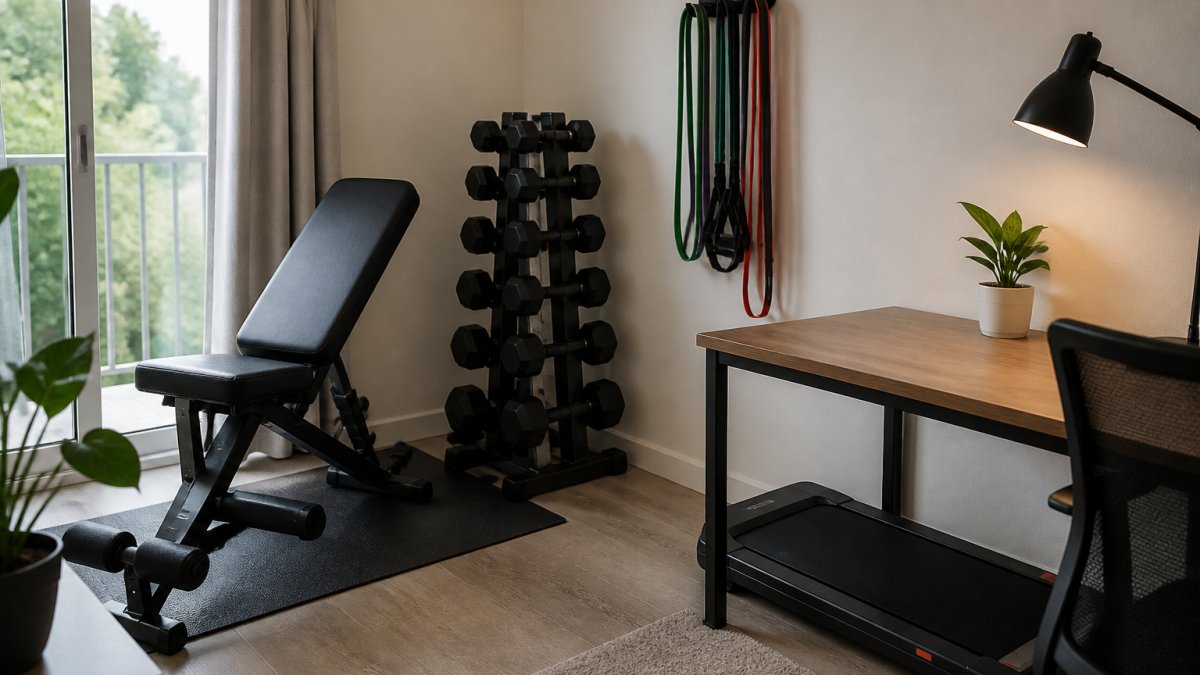
Layout principles that work in real apartments:
- Store vertically: wall hooks for bands, a rack for dumbbells, a folded bench against the wall
- Keep one clear zone: tape a workout area and keep it free of furniture
- Choose coordinated gear: matching equipment looks intentional rather than scattered
- Use the dead space: under a desk, behind a door, or beside a wardrobe
For a 600 sq ft apartment, a single corner of roughly 2 x 2 metres holds a complete setup. For a studio, a wall-mounted system plus adjustable dumbbells covers everything.
Common Mistakes to Avoid When Buying Small Room Gym Equipment
The biggest mistake is buying for the workout you imagine rather than the room you have. Equipment that does not fit gets stored and forgotten.
Other frequent errors:
- Ignoring storage time: gear that takes five minutes to assemble never gets used
- Skipping the flooring: vibration and noise complaints end routines fast
- Overbuying at once: start with dumbbells and bands, add cardio later
- Choosing looks over durability: check weight limits and build quality, not just finish
Conclusion: Build a Small Room Gym That Lasts
The best home gym equipment for small rooms is the gear you will actually set up, use, and put away without resenting the space it takes. Measure first, protect your floor, and buy in stages. IRONINFINITY builds tailored home gyms with space-efficient equipment that integrates into your home and keeps your workout flow intact. Explore our space-efficient equipment and athletic apparel to design a setup that fits your room and your routine.
Frequently Asked Questions
How much space do you need for a home gym?
A functional home gym can fit in as little as 15 to 30 square feet if you choose foldable or vertical storage equipment. Measure your available floor area, ceiling height, and clearance for movements like overhead presses. For a compact setup, aim for a 6 x 6 foot zone that you can clear when training and reclaim afterward.
What is the best compact cardio equipment for a small apartment?
Walking pads and foldable treadmills are the most space-efficient cardio options for apartments. They slide under a bed or sofa and produce less vibration than running treadmills. Jump ropes and compact exercise bikes are also strong choices. Look for models with a low deck height and rubberized feet to reduce noise transfer to neighbors below.
How can you store workout equipment in a small apartment?
Use vertical storage: wall-mounted racks for dumbbells, hooks for resistance bands, and foldable benches that stand upright. Choose equipment that folds flat or nests, like adjustable dumbbells and collapsible cardio machines. A dedicated storage cabinet or under-bed bin keeps smaller items like jump ropes and ab rollers out of sight. IRONINFINITY designs storage solutions that integrate with your room's layout.
How do you organize a small home gym without it feeling cramped?
Zone your space: designate a clear workout area that you can reset after each session. Keep only the equipment you use weekly in the room, and store the rest. Use wall space for vertical storage and choose equipment with neutral colors that blend with your decor. A consistent layout reduces setup time and helps you stay motivated.
A small room is not a limit on your training. It is a design brief. IRONINFINITY helps you answer it with tailored home gym design, space-efficient equipment, and gear that integrates seamlessly into your living space, so your daily fitness ritual stays focused and intentional. Shop now to build a home gym that fits the room you have.