
Table of Contents
- Why Home Workouts Test Your Motivation
- Build a Home Workout Routine for Beginners
- Create a Home Workout Schedule You'll Actually Follow
- Design Your Dedicated Workout Space
- Ways to Make Exercise Fun at Home
- Track Workout Progress Beyond the Scale
- What to Do on Low-Motivation Days
- Build Habits That Stick Without Willpower
- Frequently Asked Questions
Last Updated: October 14, 2026
Why Home Workouts Test Your Motivation
The challenge of how to maintain workout motivation at home is harder than most people expect. Your couch is steps away. Distractions are everywhere. There's no trainer pushing you, no community energy, no one watching.
The pattern is clear: motivation crashes in week three or four. Not because people are lazy. Because home workouts lack the environmental cues that made the gym work.
The gym forced you to commit. You drove there. You paid money. You showed up in public. All of those friction points actually helped. They made quitting harder than staying.
At home, the friction disappears. That's the real problem to solve.
The good news: you don't need more willpower. You need a different system. One built specifically for home training, where motivation naturally dips and external accountability is zero.
Build a Home Workout Routine for Beginners
A home workout routine for beginners works best when it's simple enough to stick to. Complexity kills consistency. Most people start with too many exercises, too many days per week, and too much intensity.
Start with three days per week. Pick four to five exercises that work your whole body. Do each for eight to twelve reps. That's it.
Here's why this works:
- Three days feels manageable, not overwhelming
- Four to five exercises take twenty to thirty minutes
- Full-body sessions trigger adaptation faster
- You can repeat the same workout, building confidence through repetition
Common beginner exercises you can do at home:
- Bodyweight squats (legs, core)
- Push-ups or wall push-ups (chest, shoulders, arms)
- Lunges (legs, balance)
- Plank holds (core, stability)
- Step-ups on stairs (legs, cardio)
Pick one from each category. Stick with those four to five movements for four weeks before changing anything. Your body adapts faster when you repeat the same stimulus. Your brain adapts too, repetition builds confidence.
The routine doesn't need to be perfect. It needs to be doable. A simple routine you actually do beats a perfect routine you skip.
Create a Home Workout Schedule You'll Actually Follow
Set a Consistent Time Slot
A home workout schedule only works if you choose a time you'll actually protect. Not a time that sounds good in theory. A time that fits your actual life.
Most people fail at morning workouts because they set an ambitious 6 AM goal when they've never woken up at 6 AM before. They fail at evening workouts because work runs late or they're too tired.
Pick the time when you're most likely to be home, alert, and able to stick to thirty minutes. For many remote workers, that's early afternoon. For night people, it's evening. For early risers, it's morning.
The specific time matters less than consistency. Your body and mind adapt to repeated patterns. If you work out at 2 PM three days a week, by week four, you'll start feeling ready at 2 PM on those days.
Adapt Your Schedule to Your Life
Real life is unpredictable. You can't predict every conflict. But you can plan for the ones you know will happen.
If you work from home, you know Tuesday mornings are packed. Don't schedule workouts then. If you have kids, you know evenings are chaotic. Plan around that reality, not against it.
Here's how to build a schedule that survives real life:
- Pick three fixed days (same days every week)
- Pick a time that survives most weeks without rescheduling
- Identify one backup time slot for when the main time doesn't work
- Accept that some weeks, you'll only hit two of three workouts, that's still a win
The schedule doesn't have to be perfect. It has to be real. A schedule you actually follow beats a theoretical schedule you abandon by week two.
Design Your Dedicated Workout Space
Your environment shapes your behavior more than your willpower does. A dedicated workout space tells your brain: this is where fitness happens. It removes decision friction. It signals commitment.
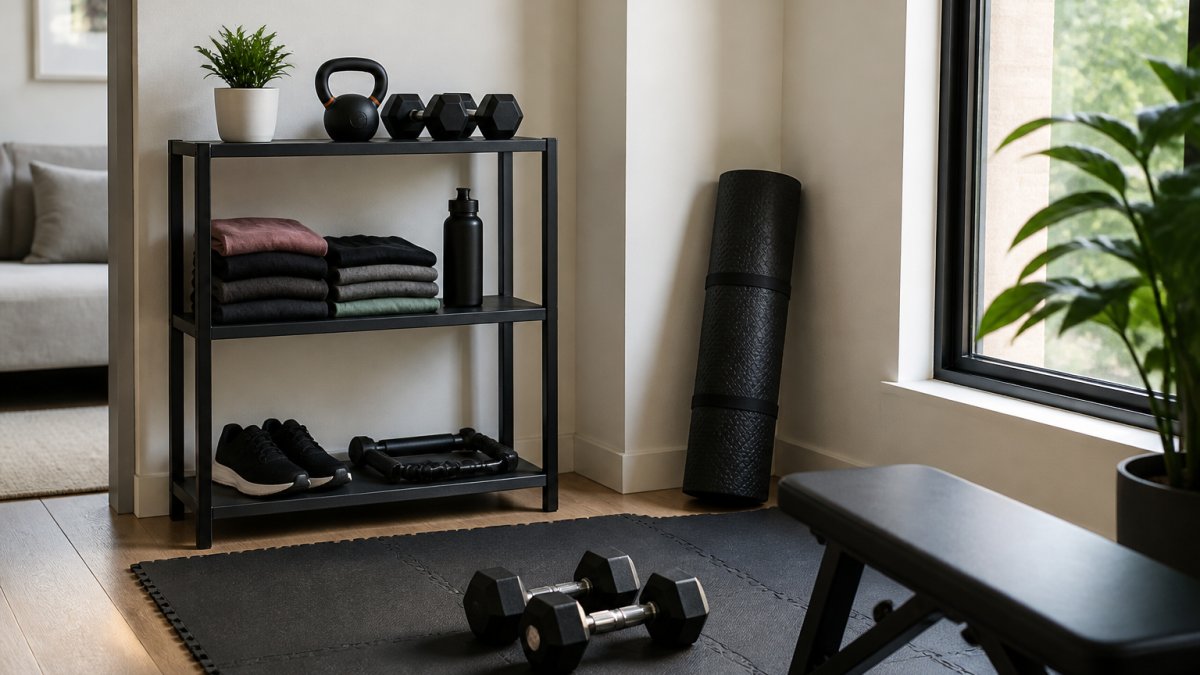
You don't need much space. You need intention.
A corner of your bedroom works. A cleared section of your living room works. Even a small balcony works. The size doesn't matter. The separation does.
Here's what makes a workout space actually work:
- It's separate from where you relax (not your couch area)
- You can leave equipment out (it stays ready)
- It has minimal visual clutter around it
- You can close a door or create a boundary if possible
The space signals a transition. When you step into it, your brain knows what's coming. That mental shift is half the battle.
Keep your space minimal and intentional. This aligns with IRONINFINITY's approach to home gym design: space-efficient solutions that integrate seamlessly into your home environment, maximizing your workout area without sacrificing your living space.
Add one or two pieces of equipment that make you feel ready. Our Go Again Women's Full Length Legging or Go Again Women's Cropped Leggings Length 21" signal that you're serious about the session ahead.


Ways to Make Exercise Fun at Home
Boredom kills consistency faster than fatigue does. The same four exercises, done the same way, for months, that gets old fast.
You don't need variety for the sake of variety. You need enough change to stay engaged without losing focus.
Here's how to add variety without chaos:
- Rotate between two or three workout styles (strength one day, movement flow another, light cardio the third)
- Change your rep ranges every four weeks (eight reps one month, twelve the next, fifteen the next)
- Add music that matches your mood and workout intensity
- Try a new exercise once per month, replacing one old one
Music is underrated. A good playlist transforms a solo home workout. It provides rhythm, energy, and distraction from discomfort. Pick songs that match your workout pace, slower for strength work, faster for cardio or movement.
Go Again Women's Cropped Leggings Length 21" →
The key is structure within variety. You're not randomly changing everything. You're making planned, small shifts that keep things fresh without breaking your routine.
Track Workout Progress Beyond the Scale
Most people track workouts wrong. They focus on weight or appearance, then get discouraged when progress is invisible.
Tracking workout progress works better when you measure what actually changes first: strength, endurance, consistency, how you feel.
Here's what to track:
- Reps completed (did you do ten reps last week, twelve this week?)
- How long you can hold a plank (add five seconds each week)
- How many rounds you complete in a set time
- Days per week you actually worked out (consistency is progress)
- How you feel after the workout (more energy? less soreness?)
These metrics move faster than weight or appearance. They're also more motivating because you see progress weekly, not monthly.
A simple tracking system:
- Write down the date, exercise, reps, and how you felt
- Check it weekly to spot the trend
- Celebrate small wins (one more rep, five more seconds, all three workouts completed)
Progress tracking creates feedback loops. Your brain responds to visible progress. When you see that you completed twelve reps instead of ten, your brain registers that as success. That success builds momentum.
What to Do on Low-Motivation Days
Low-motivation days are inevitable. Cold mornings. Stressful work days. Sore muscles. Days when the couch wins.
Most guides tell you to "push through" or "just start and you'll feel better." That works sometimes. It doesn't work always.
A better approach: have a low-motivation workout ready.
This is a shorter, easier version of your normal workout. Same exercises. Fewer reps or rounds. Maybe ten minutes instead of thirty. The goal isn't intensity. It's showing up.
Your low-motivation workout might look like:
- Five minutes of light movement (stretching, walking, easy yoga)
- Five rounds of five reps each of your main exercises
- Five minutes of breathing or cool-down
This takes fifteen minutes. It's not impressive. It doesn't feel like a "real" workout. It doesn't matter. You showed up. You moved. You maintained the habit.
Consistency beats intensity every single time. One year of showing up for fifteen minutes beats three months of intense workouts followed by six months of nothing.
The low-motivation workout removes the decision. You don't negotiate with yourself about whether to work out. You already decided: on hard days, you do the short version.
Build Habits That Stick Without Willpower
Willpower is overrated. Habits are underrated.
Willpower is a limited resource that depletes throughout the day. By evening, you have almost none left.
The shift from motivation to habit takes about four weeks of consistency. After that, showing up becomes the default, not the exception.
Here's how to build the habit:
- Pick a specific time and day (Tuesday, Thursday, Saturday at 2 PM)
- Attach your workout to an existing habit (after coffee, before lunch, right after work)
- Do the same workout for at least four weeks
- Track completion with a simple calendar (mark an X for each day you do it)
The calendar creates accountability without judgment. You see the pattern. Missing one day is fine. Missing two in a row is a warning sign.
By week four, your brain starts expecting the workout at that time. Your body starts preparing for it. The habit takes over from motivation.
Maintain workout motivation at home by treating it as a habit, not a choice. Once it's a habit, motivation becomes irrelevant.
The clothes you wear matter too. Our Mesh It To Me Tank and Excel Jogger 7/8 Length 28" Pant create that intentional shift, you're not just moving around your home, you're training.

Home workouts fail when motivation is the only fuel. They succeed when systems replace motivation.
IRONINFINITY specializes in crafting tailored home gyms that elevate your daily fitness rituals with precision and intention.
| Strategy | Purpose | Timeline |
|---|---|---|
| Set consistent time | Build automatic habit | Week 1-2 |
| Design dedicated space | Remove decision friction | Week 1 |
| Simple 3-4 exercise routine | Build confidence through repetition | Week 1-4 |
| Track reps or rounds | Create visible progress | Ongoing |
| Low-motivation backup workout | Maintain consistency on hard days | As needed |
| Wear intentional gear | Signal training mindset | Every session |
Frequently Asked Questions
How do I stay motivated to work out at home when I used to go to a gym?
The shift from gym to home requires deliberate structure. Set a fixed workout time, create a dedicated space that signals 'training zone,' and track progress metrics beyond appearance, strength gains, endurance, or consistency streaks. Home workouts thrive on habit, not motivation. Pair your workout with an existing routine (after morning coffee, before lunch) so it becomes automatic. Invest in quality apparel like IRONINFINITY's Go Again leggings that make you feel equipped and intentional, which reinforces the ritual.
What should I do when I don't feel like working out at home?
Low-motivation days are inevitable. Instead of relying on willpower, use the 'two-rep rule': commit to just two minutes or one warm-up set. Most people find momentum once they start. If genuine fatigue or soreness is present, replace the session with gentle mobility work or a walk. The goal is maintaining the habit chain, not intensity. On truly off days, a 10-minute yoga flow counts. This preserves consistency without burnout and keeps the identity of 'someone who works out' intact.
How can I track progress with home workouts if I don't have gym equipment?
Progress tracking at home goes beyond weight. Log reps, sets, and rest times for bodyweight exercises. Track endurance (how long you hold a plank), speed (burpees in 10 minutes), or recovery (resting heart rate). Use a simple spreadsheet or phone notes to record workouts, this creates a feedback loop that builds confidence. Photograph your form monthly to spot improvements in posture or range of motion. Progress tracking reinforces the habit and provides proof that consistency works, which sustains motivation during plateaus.
How long should a home workout be to stay consistent?
Consistency beats duration. A 20-30 minute workout done three times per week outperforms an occasional 90-minute session. Short, frequent workouts fit small apartments and busy schedules better. Start with 15-20 minutes to build the habit, then extend as consistency solidifies. The real win is showing up regularly, not crushing yourself once a month. Quality apparel like IRONINFINITY's Mesh It To Me Tank supports focused, shorter sessions where every minute counts toward your fitness goals.