
Table of Contents
- Start with a Clear Fitness Vision Before You Buy Anything
- Small Home Gym Design: Measure Your Room and Map the Layout
- Home Gym Equipment for Small Spaces: Choose Versatile Essentials
- Minimalist Home Gym Storage Solutions That Keep the Room Livable
- Build a Budget Home Gym Setup Without Sacrificing Quality
- Floor Protection, Noise Control, and Airflow for Shared Spaces
- How to Design a Minimalist Home Gym That Grows With You
- Frequently Asked Questions
Last Updated: October 19, 2026
Start with a Clear Fitness Vision Before You Buy Anything
A minimalist home gym is a small, carefully chosen set of equipment that supports your actual training goals inside the space you really have.
Most people buy equipment first and figure out the training later, ending up with mismatched gear and no clear routine.
At IRONINFINITY, we design around the opposite order: goal first, space second, equipment last.
Start by answering three questions in writing:
- What are your two main training goals for the next six months?
- How many days per week will you realistically train at home?
- Which single lift or movement would you refuse to give up?
Those answers decide everything that follows.
Be honest about frequency. A setup built for five sessions a week looks very different from one built for two.
Small Home Gym Design: Measure Your Room and Map the Layout
Small home gym design starts with a tape measure, not a shopping cart.
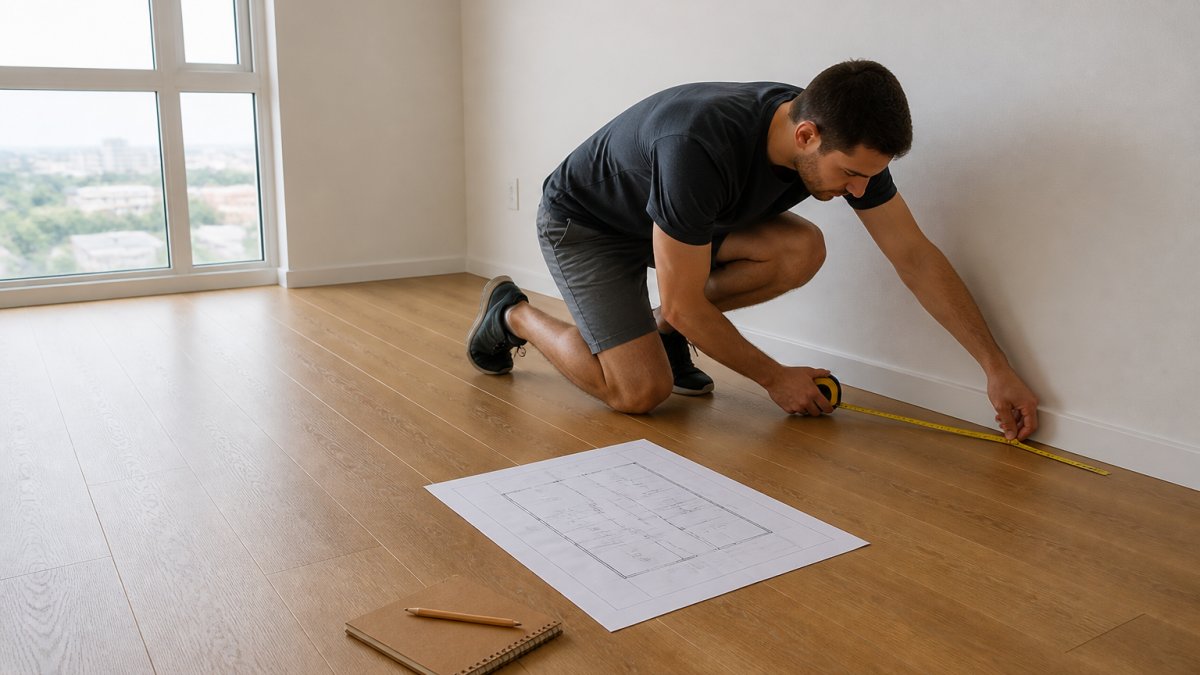
Sketch a simple floor plan on paper or use a free room-planning app. Mark five things:
- The wall you'll use for storage or a rack
- The open floor area you need for movement
- Door swing zones you cannot block
- Any fixed furniture that stays
Then subtract clearance. You need room to extend your arms, step back from a bench, and set weights down safely, measuring only the equipment footprint is a common mistake.
Here are working clearance numbers most home lifters find sufficient:
- Bench press: allow 2 feet behind the bench head for a spotter or bail-out, and 1 foot on each side of the bar.
- Overhead press: add 1 foot in front and behind, plus ceiling height equal to your reach plus 6 inches.
- Squat or deadlift: 3 feet in front and 2 feet on each side for plate loading and safe bailing.
- Pull-up bar: 2 feet in front and behind for leg clearance, and enough ceiling height for your full hang plus 6 inches.
For most free-weight work, plan a clear zone roughly the length of your body plus an arm's reach on each side.
Check ceiling height before buying anything tall. Overhead presses and pull-up bars need vertical clearance, and low ceilings rule out certain racks.
Clearance Zones and Safety Checkpoints
Clearance is the space you need around equipment to move and bail out safely. Treat it as fixed.
Run through this checklist before you commit to a layout:
- At least one arm's length of clear floor on every side of a bench
- Enough room to step back from a rack without hitting furniture
- No equipment within a door's swing path
- Ceiling height checked for any overhead movement
- A clear path to the exit in case of an emergency
If a layout fails even one check, move the equipment rather than the safety rule.
A Worked Example: Fitting a Minimalist Gym into a 10×12 Room
Suppose you have a spare bedroom that measures 10 feet by 12 feet with an 8-foot ceiling. You want adjustable dumbbells, a folding bench, and a pull-up bar.
Place the bench along the 12-foot wall with 2 feet behind the head and 1 foot on each side, about 3 feet of width and 6 feet of length.
That leaves a central open zone of roughly 6 feet by 6 feet for floor work and stretching.
Home Gym Equipment for Small Spaces: Choose Versatile Essentials
Home gym equipment for small spaces should do more than one job.
The test for any purchase is simple: how many of your two stated goals does it serve? If the answer is one, and it's a niche item, leave it.
The honest trade-off: adjustable dumbbells take longer to change between sets than fixed pairs, and the mechanisms can feel less solid at heavy loads.
Compare Equipment by Footprint, Cost, and Exercise Coverage
Use this comparison to see what each item costs you in space and money, and what it gives back in exercise options.
| Equipment | Typical Footprint (stored) | Relative Cost | Exercise Coverage | Upgrade Potential |
|---|---|---|---|---|
| Adjustable dumbbells (pair) | 2 sq ft on a rack | Medium | Press, row, squat, hinge, carry | Add heavier plates or a second pair |
| Fixed dumbbells (2-3 pairs) | 4-6 sq ft on a rack | Medium to high | Same as above, faster changes | Add pairs as needed |
| Folding bench (incline/flat) | 2 sq ft leaned against wall | Low to medium | Press, row, step-up, core | Add a barbell later |
| Pull-up bar (doorway or wall) | 0 sq ft (wall-mounted) | Low | Back, grip, core | Add rings or a dip attachment |
| Resistance bands (set) | 1 sq ft in a bin | Low | Warm-up, accessory, mobility | Add handles or a door anchor |
| Kettlebell (one or two) | 1-2 sq ft | Low to medium | Swing, goblet squat, carry | Add a heavier bell |
| Rower or bike | 6-10 sq ft | High | Cardio, conditioning | Limited |
Use the table to avoid redundant gear. Adjustable dumbbells plus a folding bench cover most strength movements; fixed dumbbells duplicate those exercises for faster set changes.
A common pattern among minimalist home lifters: start with adjustable dumbbells, a folding bench, and bands, then add a pull-up bar once the habit sticks, keeping cost and footprint low while covering strength, accessory work, and mobility.
The Minimalist Equipment Checklist by Workout Goal
Match your kit to your goal, and nothing else.
| Primary Goal | Core Equipment | Optional Add-On | Floor Space Needed |
|---|---|---|---|
| Strength | Adjustable dumbbells, flat/incline bench | Barbell and plates | Medium to large |
| General fitness | Dumbbells, resistance bands, mat | Kettlebell | Small |
| Low-impact cardio | Mat, resistance bands, step | Rower or bike | Small to medium |
| Mobility and recovery | Mat, bands, foam roller | Light dumbbells | Very small |
| Full-body minimal | Adjustable dumbbells, bench, pull-up bar | Bands | Medium |
Pick one row. Build it out fully before adding anything from a second row.
Go Again Women's Cropped Leggings Length 21" →
For training apparel that keeps up with a compact routine, our Go Again Women's Cropped Leggings are built for repeated sessions, with a high-rise stay-put waistband and two side hip pockets. The Excel Jogger 7/8 Length Pant uses a four-way stretch woven fabric with elastic cuffs, so it moves through floor work without bunching.


Minimalist Home Gym Storage Solutions That Keep the Room Livable
Minimalist home gym storage solutions keep equipment off the floor and out of sight between sessions, so the room resets in under two minutes.
Vertical storage does most of the work. Wall-mounted racks hold dumbbells and bands at eye level. A folding bench leans against the wall.
Try this reset routine:
- Return all weights to the rack, heaviest at the bottom.
- Fold and hang the bench.
- Wipe down the mat and roll it upright.
- Put bands and small tools in their labeled bin.
- Do a ten-second floor check for stray items.
Label every bin. Shared rooms fall apart when nobody knows where the resistance bands live.
Build a Budget Home Gym Setup Without Sacrificing Quality
A budget home gym setup is about spending in the right order, not spending the least. Buy the items you'll touch every session first, and buy them well.
Spend here:
- Adjustable dumbbells or a solid pair of fixed dumbbells
- A sturdy bench rated for your working weight
- A good mat with real grip
Save here:
- Branded accessories you'll rarely use
- Duplicate items that do the same job
- Decorative storage before you know your layout
The cheapest equipment often costs more over time, a wobbly bench or slipping bar gets replaced within a year.
Quality shows in the details: welds, stitching, grip texture, and how a product holds up after repeated use. Our Excel Women's Workout Shorts use squat-proof, four-way stretch fabric with a hidden drawcord and a discreet waistband pocket, which is the kind of construction that survives a daily routine. The Pionxr Bra Top pairs moisture-wicking fabric with medium support for low-to-medium impact training.

Set a total budget and split it roughly three ways: weights, bench or rack, and flooring plus storage.
Floor Protection, Noise Control, and Airflow for Shared Spaces
For the floor, rubber gym tiles or a dense mat under the weights absorb impact and protect wood or tile.
For noise, the culprits are dropped weights and vibration through the structure.
For airflow, keep a window or vent open during sessions and add a small fan, which moves air without taking floor space.
Lighting matters too. A bright, simple light source makes a small room feel larger and keeps the space looking intentional rather than improvised.
How to Design a Minimalist Home Gym That Grows With You
A minimalist home gym should be designed to expand in stages, not all at once. The trick is buying equipment that accepts upgrades.
Plan your growth in three phases:
- Phase 1 (months 1-3): Dumbbells, bench, mat, bands. Prove the habit.
- Phase 2 (months 4-9): Add a pull-up bar, heavier dumbbells, or a barbell if strength is the goal.
- Phase 3 (month 10+): Add cardio or a rack only if a specific goal needs it.
Review your setup every quarter.
Keep a simple maintenance routine: check bolts and connections monthly, wipe down grips, and inspect mats for wear.
That's the whole method. Define the goal, measure the room, buy versatile essentials, store them vertically, and grow in phases.
Frequently Asked Questions
How much space do you need for a minimalist home gym?
A functional minimalist home gym can fit into a 2m x 2m area, roughly 4 square metres. That footprint accommodates a compact bench, a pair of dumbbells, and a mat with room for safe movement. For barbell work or a pull-up bar, plan for at least 2.5m x 2.5m and check ceiling height: you need 30cm above your reach. Measure your room, mark the training zone with tape, and confirm you can extend your arms fully without hitting walls or furniture.
What equipment do you need for a minimalist home gym?
Start with adjustable dumbbells, a flat weight bench, resistance bands, and a pull-up bar. That set covers strength training for every major muscle group and fits into a corner. Add a kettlebell or a barbell only if your workout goals demand heavier loads. A compact cardio option like a jump rope or a foldable bike handles low-impact cardio without a permanent footprint. Choose multi-use equipment over single-purpose machines to keep the space open and the budget controlled.
How do you store home gym equipment without creating clutter?
Use vertical storage: wall-mounted racks for dumbbells, hooks for resistance bands, and a ceiling or wall mount for your pull-up bar. A slim storage bench with a hinged lid hides mats, ropes, and small accessories. Choose equipment that folds or nests, and adopt a reset routine: every item returns to its place after each session. In shared rooms, a folding screen or a curtain can conceal the gym wall in seconds, keeping the space feeling like a home rather than a fitness club.
Can you build an effective home gym on a budget?
Yes. Prioritise adjustable dumbbells, a sturdy flat bench, and resistance bands, which together cover strength training for most people at a fraction of the cost of a full machine setup. Buy essentials first and add pieces as your routine stabilises. Watch for total cost, not just sticker price: cheap equipment that wobbles or wears out costs more over time. Invest in a solid foundation, a flat floor, and a bench that supports your body weight plus the load, then expand gradually.
Most home gyms fail on clutter, not on equipment quality. The fix is a design that fits your room and your goals from the first purchase. IRONINFINITY builds tailored home gym solutions with space-efficient equipment that integrates into your living space, so your workout area stays focused and your room stays livable. Explore the collection and start with the essentials that match your training plan.