
Table of Contents
- Assess Your Space: Measuring and Planning Your Small Apartment Home Gym
- Home Gym Equipment for Small Spaces: What Actually Fits
- Small Home Gym Layout Ideas for Common Apartment Footprints
- Small Room Gym Storage Ideas: Keep Your Space Clear
- Apartment-Friendly Workout Equipment: Noise and Floor Protection
- Set Up Your Workout Routine in Your Small Apartment Gym
- Make Your Space Work: Design and Lighting Touches
- Frequently Asked Questions
Last Updated: October 16, 2026
Assess Your Space: Measuring and Planning Your Small Apartment Home Gym
A small apartment home gym doesn't require much square footage, just the right plan. Before you buy a single piece of equipment, measure what you actually have. Most apartments have more usable space than you think.
Calculate your usable floor space
Start by measuring the length and width of your intended workout area in feet. Multiply those numbers together to get your total square footage. A 10-by-6-foot bedroom corner gives you 60 square feet. That's enough for strength training, yoga, and basic cardio.
Write down these measurements:
- Total room length and width
- Distance from walls to any obstacles (closets, doors, windows)
- Ceiling height (important for tall equipment or jumping)
- Distance from doorway to the farthest wall (your clearance zone)
Account for clearance and safety zones
You need room to move. A dumbbell needs clearance on all sides. A yoga mat requires space to lie down fully. A resistance band needs room to extend.
Add these clearance zones to your plan:
- Around dumbbells: at least 2 feet on each side
- For a yoga mat: the full mat length plus 1 foot at the head
- For resistance band work: 6 feet of open space in front of you
- For jumping or burpees: 3 feet of clear overhead space
Safety zones prevent accidents. They also make your workouts feel less cramped. A 6-by-8-foot corner with proper clearance feels spacious even in a small apartment.
Home Gym Equipment for Small Spaces: What Actually Fits
Not all fitness equipment works in a small apartment. Bulky machines take up floor space you can't spare. Smart choices mean you train hard without feeling boxed in.
Adjustable dumbbells and resistance bands
Adjustable dumbbells replace an entire rack of fixed weights. One set takes up the space of three or four pairs.
Resistance bands cost almost nothing and weigh nothing. They hang on a wall hook or roll up inside a drawer. They work for strength training, mobility work, and stretching.
Why these two work together:
- Dumbbells handle heavy strength work
- Bands add variety and reduce joint stress
- Together they cover 80 percent of training needs
- Both store easily in minimal space
Foldable benches and collapsible cardio options
A foldable weight bench opens flat for dumbbell work, then folds upright to lean against a wall. It takes up maybe 2 feet of wall space when stored.
Collapsible cardio options include:
- Folding jump rope (stores in a drawer)
- Resistance bands for cardio intervals
- Bodyweight circuits that need no equipment
- Rowing machine that folds in half
A rowing machine is one of the few pieces of cardio equipment that works in small spaces. It folds down to roughly 2 feet wide and 7 feet long.
Yoga mats and bodyweight training surfaces
A yoga mat defines your training zone. It protects your floor, reduces noise for neighbors, and gives you a clear boundary for your workout space.
Yoga mats come in standard sizes (68 inches long, 24 inches wide). Roll it up and it fits in a closet. Lay it down and it becomes your training area for:
- Bodyweight strength (push-ups, planks, burpees)
- Core work (crunches, leg raises, mountain climbers)
- Stretching and mobility
- Yoga and Pilates
A yoga mat also signals to your brain that this space is for training. That mental shift matters when your gym is in your bedroom.
Small Home Gym Layout Ideas for Common Apartment Footprints
Real apartments have real dimensions. Here's how to set up three common configurations.
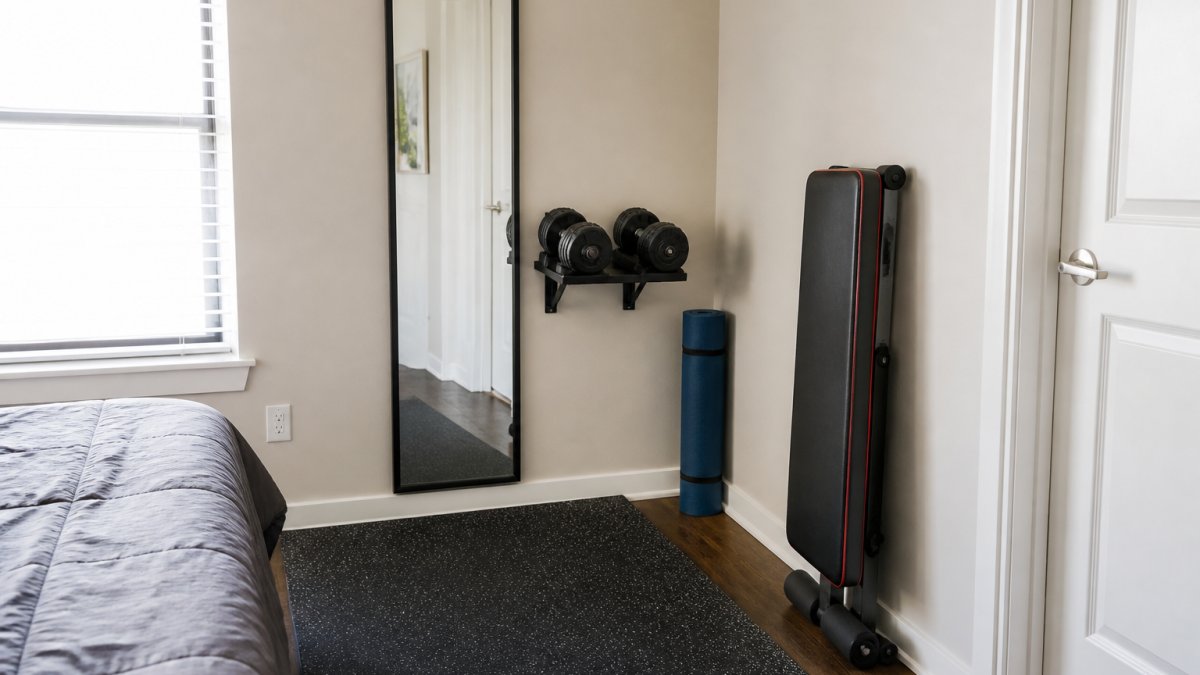
The corner nook setup (6 by 8 feet)
This layout fits a bedroom corner or living room alcove. Position your yoga mat in the center, leaving 2 feet of clearance on all sides.
Place adjustable dumbbells in a corner rack along one wall. Store a foldable bench against the wall behind you.
Your training flow:
- Start with dumbbells for strength (standing in the center)
- Move to the mat for core and bodyweight work
- Use resistance bands for finishing exercises or mobility
This setup takes roughly 15 minutes to fully clear. Everything stores vertically against walls.
The living room corner station (8 by 10 feet)
Living rooms offer more flexibility because you can use the space strategically.
Keep dumbbells in a compact stand or rack in one corner. A small shelf above holds resistance bands and smaller items.
Your training flow:
- Warm up with light band work or mobility
- Move to the mat for your main workout
- Use dumbbells for strength finishers
- Everything packs away in under 10 minutes
This layout works because the living room is already a multipurpose space. Your gym becomes one use among many, not the dominant feature.
The bedroom wall-to-wall layout (10 by 6 feet)
A narrow bedroom corridor is perfect for linear training. Align your mat lengthwise along the room.
Mount a small shelf or wall organizer for bands and accessories. A folding bench can lean in a corner or slide under the bed.
Your training flow:
- Start at one end with dumbbells
- Move along the mat for bodyweight and core work
- Finish at the other end with stretching or mobility
This layout maximizes a long, narrow space. You move in one direction, which keeps your workout focused and efficient.
Small Room Gym Storage Ideas: Keep Your Space Clear
Storage determines whether your gym stays usable or becomes clutter. The best storage is invisible or doubles as furniture.
Under-bed and behind-the-door storage
Under-bed storage containers hold rolled resistance bands, jump ropes, and smaller items. Flat boxes slide easily and keep everything organized.
Behind-the-door hooks or racks hold resistance bands. A slim over-the-door organizer stores accessories without taking floor space.
Why this works:
- Uses space that's already there
- Items are out of sight but accessible
- Takes seconds to access or put away
- Costs very little to set up
Corner shelves and wall-mounted racks
A corner shelf unit uses dead space. Mount it 4 to 6 feet high so it doesn't block sightlines.
Wall-mounted dumbbell racks hold adjustable dumbbells vertically. They save floor space and make dumbbells part of the room's design rather than clutter.
A pegboard on one wall organizes small items and adds visual interest. Hooks hold bands, ropes, and small tools.
Modular storage benches that double as seating
A storage bench serves two purposes. It holds equipment underneath and functions as a seat or step platform during workouts.
Look for benches with:
- Hinged tops for easy access
- Internal dividers for organization
- Sturdy construction to support your weight
- A footprint under 3 feet long
This approach turns storage into furniture. Your gym doesn't look like a storage facility.
Apartment-Friendly Workout Equipment: Noise and Floor Protection
Neighbors matter. So does your security deposit. Noise and floor damage are real concerns in apartments.
Rubber mats and stall mats for vibration control
Rubber mats absorb impact and reduce noise. A 3/8-inch-thick rubber mat works for most bodyweight and dumbbell training. For heavier lifting or jumping, go thicker (1/2 inch or more).
Stall mats (interlocking rubber tiles) are modular. You add or remove tiles based on your needs. They're common in horse facilities but work perfectly in apartments.
Why rubber works:
- Absorbs sound from dumbbells and footsteps
- Protects floors from damage
- Provides cushioning for joints
- Doesn't slip under weight
Silent equipment choices and neighbor-considerate workouts
Some exercises are naturally quieter. Resistance band work produces almost no noise. Dumbbells make noise when dropped but not during controlled movements.
Choose quiet training methods:
- Resistance band strength work
- Bodyweight exercises (push-ups, planks, yoga)
- Controlled dumbbell movements (no dropping)
- Low-impact cardio (step-ups, lateral shuffles)
- Stretching and mobility work
Avoid equipment that generates noise:
- Treadmills (footsteps echo)
- Rowing machines on hard floors (seat slides loudly)
- Plyometric movements on thin flooring (jumping creates impact)
- Heavy kettlebells or medicine balls (loud when set down)
Training early morning or late evening shows consideration. Midday workouts are generally fine for quiet exercises.
Set Up Your Workout Routine in Your Small Apartment Gym
Your space dictates your routine structure. Work with your layout, not against it.
Strength and core training in minimal space
Strength training needs less space than you think. A pair of dumbbells and your bodyweight cover most needs.
Sample strength routine for small spaces:
- Dumbbell squats (standing in place)
- Push-ups (on your mat)
- Dumbbell rows (standing in place)
- Planks and dead bugs (on your mat)
- Dumbbell shoulder presses (standing in place)
This routine uses maybe 4 feet of floor space.
Core work is ideal for small spaces. Planks, dead bugs, pallof presses with bands, and leg raises all happen on your mat.
Cardio, yoga, and mobility work without equipment overflow
Cardio doesn't require machines. Bodyweight circuits create intensity in a small space.
Try this 10-minute cardio circuit:
- 40 seconds of jumping jacks
- 20 seconds rest
- 40 seconds of burpees
- 20 seconds rest
- 40 seconds of high knees
- 20 seconds rest
- Repeat 3 times
Yoga flows use your mat and your bodyweight. Sun salutations, warrior poses, and downward dog all happen in place. No equipment needed.
Mobility work is perfect for small spaces. Hip openers, shoulder stretches, and spinal rotations happen on your mat.
Make Your Space Work: Design and Lighting Touches
Your gym should feel intentional, not like equipment crammed into a corner. Design details matter.
Mirrors to expand the visual space
A mirror makes a small space feel larger. It also helps you check your form during exercises.
A 4-by-6-foot mirror leans against a wall or mounts above your training area.
Mirrors serve practical and psychological purposes. You see your form. You see the space differently. Your brain perceives the area as bigger.
Lighting and ventilation for focus and comfort
Natural light is ideal. Position your mat near a window if possible. Morning light energizes you.
If natural light is limited, add task lighting.
Ventilation matters. Open a window during workouts. A small fan keeps air moving without taking up much space.
Color and simplicity matter too. Neutral walls keep the focus on your training. Minimal clutter reduces visual noise.
A small apartment home gym works because it fits your life, not the other way around. Our space-efficient solutions, including the Mesh It To Me Tank and Excel Women's Workout Shorts, are designed to support focused, intentional training in any footprint.
Frequently Asked Questions
How much space do you actually need for a small apartment home gym?
A functional small apartment home gym can work in as little as 60 to 100 square feet. A 6-by-8-foot corner or an 8-by-10-foot living room section is enough for strength training with dumbbells, resistance bands, and bodyweight work. The key is vertical storage and choosing compact, foldable equipment. Even a 10-by-6-foot bedroom wall can accommodate a complete workout setup with proper organization.
What apartment-friendly workout equipment takes up the least space?
Adjustable dumbbells, resistance bands, yoga mats, and pull-up bars are the most space-efficient options. Adjustable dumbbells replace an entire rack of weights in a fraction of the footprint. Resistance bands roll into a small pouch. Foldable benches and collapsible cardio tools store behind doors or under beds. These choices let you perform strength, cardio, and mobility work without dominating your living area.
How do you reduce noise and vibration in a small apartment gym?
Invest in rubber mats or stall mats at least 0.5 inches thick to absorb impact and vibration. Place mats under all equipment, especially where dumbbells land or cardio equipment sits. Choose silent equipment like resistance bands and bodyweight exercises over high-impact cardio. Schedule workouts during reasonable hours and avoid dropping weights. These steps protect your floors and keep neighbors happy while maintaining your workout intensity.
What's the best small home gym layout for a 600 square foot apartment?
In a 600 sq ft apartment, claim a single zone: either a bedroom corner, living room nook, or home office alcove. A 6-by-8-foot or 8-by-10-foot area is sufficient. Position your mat and primary equipment (bench or mat) in the center, with storage on walls and under furniture. Use vertical space with corner shelves and behind-the-door racks. This approach keeps your gym contained, maintains clear pathways through your apartment, and prevents the space from feeling like a commercial facility.