
Table of Contents
- Why Urban Professionals Choose Luxury Home Gym Alternatives
- Space-Efficient Home Gym Design Without Compromise
- Custom Home Gym Cost: Understanding the Investment
- Is Home Gym Equipment Worth the Investment?
- Luxury Home Gym Ideas for Small Apartments
- Service Comparison: Design, Installation, and Support
- Red Flags and Mistakes to Avoid
- Frequently Asked Questions
Last Updated: October 18, 2026
Why Urban Professionals Choose Luxury Home Gym Alternatives
Designing a premium home fitness space isn't just about equipment; luxury home gym alternatives are about how that investment fits your life. Urban professionals in compact apartments face a real tension: they want a luxury experience without sacrificing their living room to steel and rubber.
This is where alternatives to Iron House Design become compelling. High-income professionals want tailored home gym solutions that feel intentional rather than makeshift, and they'll invest in space-efficient home gym design if it matches their aesthetic standards and spatial constraints.
The core question isn't whether you need a luxury home gym alternative, it's which approach aligns with your priorities: design consultation depth, installation support, budget flexibility, or remote accessibility.
Space-Efficient Home Gym Design Without Compromise
A truly space-efficient home gym requires deliberate choices about equipment footprint and layout. The common mistake is treating space efficiency as an afterthought rather than the foundation of the design.
Start by measuring your actual available space, not the room's total square footage, but the wall length and ceiling height you can genuinely dedicate to fitness.
The best layouts prioritize vertical storage and dual-function equipment. Wall-mounted racks eliminate floor clutter. Adjustable dumbbells replace entire dumbbell sets. A single high-quality bench with storage underneath replaces three separate pieces. Mirrors on one wall create the illusion of depth while improving form visibility during workouts.
Lighting and ventilation matter more in compact spaces than in commercial gyms. Recessed perimeter lighting plus a small portable fan transforms a claustrophobic room into an intentional destination, and your environment directly influences consistency.
Custom Home Gym Cost: Understanding the Investment
Most pages about luxury home gyms avoid numbers, leaving buyers unable to budget. Confirm pricing with providers.
The Five Cost Buckets
1. Design and planning. Measured drawings, equipment schedules, electrical and lighting plans, and visualization. Remote design is the lowest-cost entry point; full-service design with site surveys and revisions sits higher.
2. Equipment. The largest single line for most projects, driven by brand tier, adjustability, and finish.
3. Flooring and acoustic treatment. Rubber or engineered flooring, subfloor preparation, and impact sound insulation matter in apartments and multi-storey homes.
4. Electrical, lighting, and ventilation. Dedicated circuits, recessed and accent lighting, and mechanical ventilation add cost but are difficult to retrofit later. Plan these before finishes are ordered.
5. Installation, project management, and contingency. Delivery, assembly, anchoring, commissioning, and building-management coordination. A contingency is a common planning allowance for unforeseen site conditions.
What Moves the Budget Most
- Structural work. Relocating walls, reinforcing floors, or adding a dedicated circuit can exceed equipment costs in older buildings.
- Building access. Upper-floor apartments without freight elevator access increase labor and scheduling complexity.
- Finish level. Custom millwork, integrated storage, and premium finishes raise cost faster than equipment upgrades in many projects.
- Scope creep during installation. Substitutions and change orders are the most common cause of overruns. Freeze the specification before ordering.
Phasing: A Practical Approach
Phase 1: essentials for your current routine plus infrastructure that's expensive to retrofit later (flooring, electrical, ventilation). Phase 2: add equipment after three to six months, when you know what you actually reach for. Phase 3: aesthetic upgrades such as millwork and accent lighting. This protects the budget and avoids buying aspirational equipment that goes unused.
Questions That Reveal True Cost
Ask: What is excluded from this quote? Who handles building approvals and certificates of insurance? What is the lead time, and what is the change-order process? What does post-installation support cost after the warranty period? The answers separate a realistic budget from an optimistic one.
Is Home Gym Equipment Worth the Investment?
This question deserves an honest answer: it depends entirely on your behavior pattern, not on the equipment quality.
Research consistently shows home gym success correlates with workout frequency before purchase, not after. If you've hit a commercial gym three times weekly for two years, a home setup will likely maintain that consistency; if you've been meaning to start, expensive equipment won't close the motivation gap.
The genuine advantage of home training is time and friction. No commute, no waiting for equipment, no social pressure.
Aesthetic integration creates another psychological benefit: when your fitness space looks intentional rather than cluttered, and equipment coordinates with your home's design style, you're more likely to use it.
Luxury Home Gym Ideas for Small Apartments
Small-space luxury requires ruthless prioritization. Every piece must earn its place through function, aesthetics, or both.
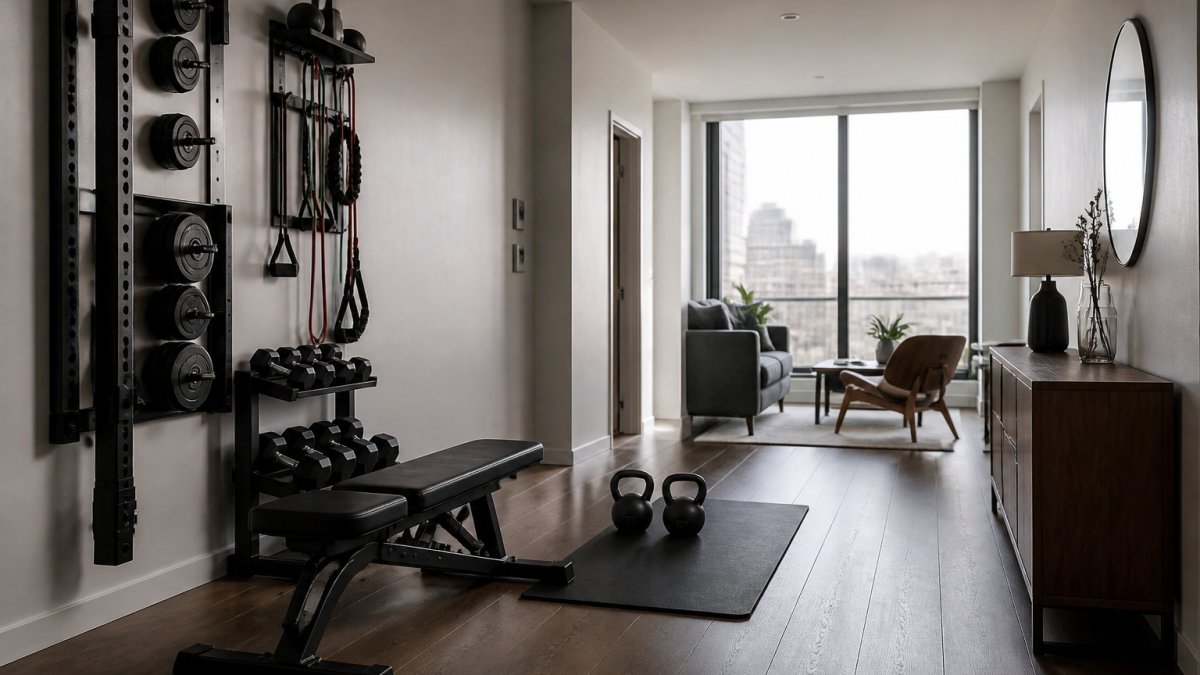
The minimalist approach focuses on multi-purpose equipment.
Color coordination and material consistency create luxury feel in compact spaces. Matching finishes across equipment, matte black frames, natural wood accents, brushed steel hardware, make a small gym feel curated rather than assembled.
Lighting design separates luxury spaces from functional ones. A commercial gym relies on harsh overhead lighting; a luxury home gym uses layered lighting: recessed fixtures for general illumination, accent lighting behind mirrors for depth, and task lighting on workout areas.
Storage solutions must be invisible or beautiful. Open shelving with neatly organized equipment looks intentional; scattered equipment looks chaotic. Wall-mounted cabinets matching your furniture create continuity, and under-bench storage keeps accessories accessible without visual clutter.
Service Comparison: Design, Installation, and Support
Most search results for Iron House Design alternatives are brand pages or equipment roundups that rarely explain what a full-service design-and-build firm does versus an equipment retailer, a remote design service, or a general contractor. That distinction is the real decision. Below is a framework for comparing providers on design scope, procurement, installation, project management, and post-installation support.
The Four Service Models You Will Encounter
1. Full-service design-and-build firm. One team handles site assessment, concept design, equipment specification, procurement, delivery, installation, and handover, giving you a single point of accountability. The trade-off is scheduling: longer lead times and possible minimum project sizes.
2. Design-only consultancy. You receive drawings, equipment schedules, and specifications, then source and install independently or through your contractor. It suits homeowners with a trusted builder or who want to control procurement.
3. Equipment retailer with installation add-on. The retailer sells equipment and may offer delivery and assembly, with design depth usually limited to layout suggestions. It's the lowest-friction path for a single-room refresh, but rarely addresses flooring, electrical, ventilation, or structural considerations.
4. Remote design service. You provide measurements, photos, and a video walkthrough; the provider returns a layout and equipment list.
What to Compare, Question by Question
Design scope. Ask for the deliverables list: measured drawings, reflected ceiling plan, electrical plan, equipment schedule with model numbers, finish schedule, and 3D visualization.
Procurement. Clarify whether the provider sources equipment directly, works through dealers, or expects you to purchase. Ask how lead times are confirmed and who bears responsibility if an item arrives damaged or is discontinued mid-project.
Installation. Distinguish delivery, assembly, mounting, and commissioning. Anchoring a rack, integrating flooring, and connecting lighting are separate scopes.
Project management. Ask who your single point of contact is, how often you receive updates, and what happens when a trade is delayed. For apartment projects, confirm experience with building rules, COI requirements, and protection of common areas.
Post-installation support. Ask about warranty terms, response times, and whether support covers adjustment and relocation, not just defects.
Geographic Coverage and Remote Options
Coverage varies widely: some firms serve a single metro with in-house crews, others operate nationally through partner installers. Ask three questions: (1) Do you have an in-house team or partners in my city? (2) Can design be completed remotely, and what is the site-survey process? (3) How are delivery and installation scheduled, and who is on site on installation day? Outside a provider's primary service area, remote design plus a local installer can work, but responsibilities must be documented in writing.
Independent Evidence to Request
Promotional imagery is not evidence. Ask for two or three recent projects in similar spaces, with before-and-after photos, a timeline, and a contactable client reference. Verify reviews on independent platforms rather than the provider's own site. A provider with a clear process welcomes these requests; one that deflects them is telling you something.
A Simple Decision Framework
- Choose a full-service firm when your project involves structural, electrical, or flooring work and you want one accountable team.
- Choose a design-only consultancy when you have a trusted contractor and want to control procurement.
- Choose a retailer with installation for a single-room equipment refresh with no building work.
- Choose a remote design service when your room is straightforward, your measurements are reliable, and budget efficiency matters more than on-site verification.
Use this framework to shortlist two or three providers, then test each against the questions above.
Red Flags and Mistakes to Avoid
Several patterns indicate a poor fit between provider and your needs.
Avoid providers who refuse to discuss budget constraints. Luxury doesn't require unlimited spending, and a provider who won't work within realistic parameters doesn't understand your situation. IRONINFINITY's space-efficient solutions provide premium quality within practical budgets.
Beware of one-size-fits-all recommendations. Your space, fitness goals, and aesthetic preferences are specific, and generic equipment lists ignore them. If a provider hasn't asked detailed questions about your routine, apartment layout, and design preferences, they're selling equipment, not solving problems.
Skip providers with unclear return policies or installation guarantees. Equipment that doesn't fit or work should have straightforward resolution.
Avoid assuming cheaper alternatives deliver equivalent results. The lowest-cost option often means minimal design consultation, DIY installation, and limited support. This works if you're highly experienced.
Designing a luxury home gym that works in a 600 square foot apartment requires more than equipment selection, it requires intentional planning that balances aesthetics, function, and space constraints. Our space-efficient solutions focus on both form and function, helping you maintain workout flow and focus without sacrificing your living space.
Frequently Asked Questions
What are the main differences between luxury home gym design services?
Premium home gym services differ in design approach, equipment curation, installation support, and geographic reach. Some offer remote consultations with 3D visualizations, while others require on-site visits. Key distinctions include whether they provide equipment sourcing, handle installation coordination, offer post-purchase support, and whether they work with small apartments or focus on larger renovations. Service quality also varies in how they balance aesthetic integration with functional performance.
Is custom home gym equipment worth the investment compared to buying pieces separately?
Custom home gym equipment worth the investment depends on your priorities. A curated, designed approach ensures pieces complement your space, fit your training needs, and integrate visually with your home. You avoid impulse purchases or mismatched equipment. However, the premium reflects design consultation, equipment selection expertise, and installation coordination. For urban professionals in small spaces or those seeking aesthetic cohesion, the investment can be beneficial. For casual users, piecemeal purchases may suffice.
Can a luxury home gym actually fit in a small apartment?
Yes, a space-efficient home gym designed for small apartments maximizes functionality. This uses wall-mounted equipment, vertical storage, multi-use pieces, and strategic layout planning. Premium design services excel at this constraint, selecting compact strength and cardio options that don't dominate the room. The key is intentional selection and placement, fewer, higher-quality pieces arranged thoughtfully.
What should I look for when comparing luxury home gym design companies?
Evaluate companies on design process transparency, equipment quality standards, whether they offer remote or on-site consultation, installation support, return policies, customer references, and geographic coverage. Ask for before-and-after photos of completed projects in spaces similar to yours. Confirm they handle the full project lifecycle, from initial planning to equipment delivery and setup. Verify their approach to small-space design and whether they prioritize aesthetic integration alongside performance.